Chapter 8 Types of support
This chapter covers the key components that keep the City Digital Twin (CDT) platform running fully and reliably. It looks at the information, software, technical, methodological, organizational, and legal aspects that underpin how the system works. Each type of support plays its own part in building a dependable digital environment, tailored to the needs of government bodies, regional administrations, analytical centers, and data operators. From references to official classifiers to readiness for deployment in a secure perimeter, this chapter shows how mature CDT is and how ready it stands for large-scale rollout.
8.1 Information support
The information support of the City Digital Twin platform is the set of sources, reference books, classifiers, and rules the system needs to run correctly and to produce reliable management data. It keeps the platform continuously fed with data, verifies and unifies that data, and maintains a single semantic model.
Information support includes:
- official statistical sources (Rosstat, the Ministry of Finance, the Federal Tax Service, Rosreestr, and others);
- industry reporting forms and departmental data;
- classifiers of territories (OKTMO, OKATO), activity types (OKVED), products (OKPD2), and units of measure (OKEI);
- municipal and regional sources (open data portals, internal administration systems);
- reference books maintained inside the platform and aligned with the calculation modules.
CDT information support rests on a multi-level system of sources that pass through validation, transformation, and matching. The system automatically tracks changes in official sources and classifiers, so all data used in modeling and reporting stays current and traceable.
Each data type has a passport that lists its source, validity period, format, update rule, and the modules that use it. This makes the platform transparent and safe when it comes to justifying management decisions and working with oversight bodies.
For a fuller description of the information support components, see the open CDT book.
8.2 Software
The software of the City Digital Twin platform is the set of technology components, modules, and tools that handle all of the platform’s functional, analytical, and visual tasks. The software architecture follows the principles of openness, scalability, import independence, and compliance with the requirements for government IT systems.
The software builds on:
- ClickHouse — the main analytical DBMS for storing data marts and running fast aggregation queries;
- R and RStudio Server — the environment for mathematical modeling, calculations, and visualization;
- GitLab CE — for storing model code and calculation versions and tracking change history;
- Docker — containerization of components, which simplifies installation and portability;
- Seafile or an equivalent — for sharing reports, exports, and supporting files;
- Nginx and a REST API — for routing, access to external systems, security, and control over interactions.
The platform is fully compatible with Russian operating systems, including Astra Linux, and you can deploy it in the customer’s closed perimeter. All modules and interfaces run in the browser and need no client software.
Depending on the customer’s needs, the software can be adapted: you can add specialized models, plug in visualization modules, and build custom API interfaces.
8.3 Technical support
The technical support of the City Digital Twin platform is the set of servers and infrastructure components that keep the software running reliably, store and process large volumes of data, and run the calculation and visualization tasks. The architecture separates the operating environments: development (DEV), testing (TEST), and production (PROD).
Each environment runs on its own set of servers:
- PROD: the main working environment, with application servers (APP), interface servers (FRONT), and database servers (ClickHouse DB);
- TEST: the environment for pre-release testing and validating updates; it mirrors the PROD architecture;
- DEV: the environment for development, experiments, and trying out new modules and user scenarios.
Standard server specifications:
- operating system: Astra Linux 1.8.1;
- RAM — up to 1024 GB on the database server;
- storage — high-reliability SSD, 4 TB or more;
- support for containerization (Docker), logging, backups, and channel encryption.
The environment delivers:
- stability under heavy load;
- fault tolerance and horizontal scaling;
- isolation of calculation environments and safe data transfer between environments.
It also provides:
- regular backup exports;
- flexible scaling thanks to the modular architecture;
- the option to deploy in a closed perimeter (the customer’s data center);
- centralized monitoring of server health and execution logs.
8.4 Methodological support
The methodological support of the City Digital Twin platform is the set of methodology documents, instructions, scenario templates, and rules that keep the approach to calculations, modeling, interpreting results, and reporting consistent. It links the technical implementation to how managers use the system.
Methodological support covers the following areas:
rules for preparing and loading data — covering formats, validation rules, and source passports;
methods for calculating socio-economic and indicative metrics, including indices of stability, balance, deficits, and surpluses;
instructions for working with the interfaces and modules — including the scenario passport, the steps to launch calculations, and how to interpret results;
algorithms for verifying and comparing scenarios — with sample calculations and visual analysis;
templates for reporting forms and decision passports — adaptable to the customer’s requirements;
recommendations for embedding the platform into the governance structure of a region, department, or project organization.
The development team maintains the methodology base, which can include:
- training presentations;
- video instructions;
- user scenario templates;
- instructions for setting up a local environment and exporting data.
For a detailed description of methodological support, see the open CDT book.
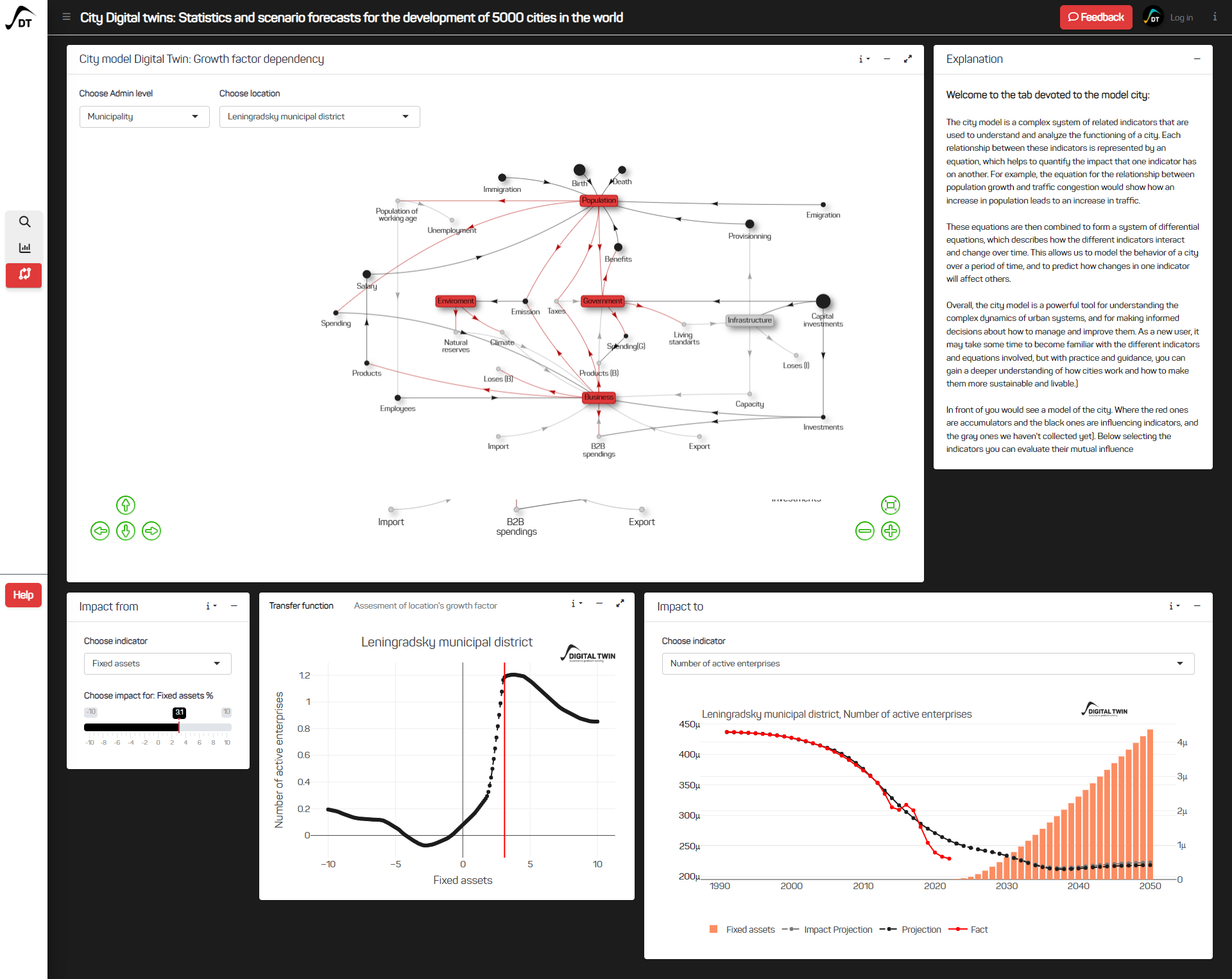
Figure 5 — Cause-and-effect model of the city: dependencies among growth factors and transfer functions
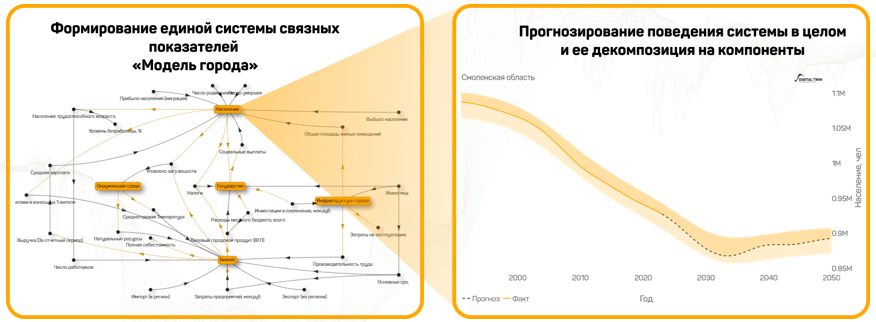
Figure 14 — Building a single system of linked metrics, the “City Model,” and forecasting system behavior with decomposition into components
8.5 Organizational support
The organizational support of the City Digital Twin platform describes the process structure, the roles, and the rules for interaction and maintenance across the platform’s entire lifecycle — from rollout and setup to day-to-day use and scaling. This type of support lets you fit CDT into the customer’s existing management, administrative, and IT processes.
Organizational support includes:
- rollout rules — a phased deployment plan, role assignments, and named owners for each block (data, models, reporting, visualization, maintenance);
- a maintenance model — a description of each team’s functions: system administrator, analyst, calculation curator, IT support;
- responsibility documents — who handles loading, verifying, and approving data and calculations;
- result acceptance — the logic for building and approving calculation and program passports, reporting forms, and scenario versions;
- exchange with external systems — defining API operators and interaction protocols;
- recommendations for setting up an in-house support service (a CDT competency center at the regional or departmental level).
The organizational principles adapt to the customer’s structure and can include integration with existing information systems, analytical units, and internal data approval rules.
8.6 Legal support
The legal support of the City Digital Twin platform covers the regulatory grounds for its rollout, operation, and maintenance as part of the digital transformation of government bodies and the public sector. The platform fully complies with the laws of the Russian Federation on information technology, data processing, and government procurement.
CDT is listed in the Unified Register of Russian Software, which confirms that it meets the criteria for import independence, an open architecture, and legal transparency. This lets customers:
- buy and roll out CDT under Federal Laws 44-FZ and 223-FZ without extra justification;
- use simplified tender procedures;
- include the platform in government and departmental IT programs.
The legal base covers:
- compliance with the law on personal data processing (Federal Law No. 152), including the use of anonymized and aggregated data sets;
- clean licensing for all components, including open-source software (MIT, GPL, AGPL) and modules handed over to the customer;
- legal grounds for multi-level distribution of responsibility for data, calculations, and scenarios;
- the option to use the platform within government information infrastructure and secure IT segments.
All rights reserved Digital Twin LLC All rights reserved Digital twin LLC