Chapter 4 Platform objectives
This chapter describes the key functional tasks that the City Digital Twin (CDT) platform handles during its rollout and operation. They cover technical and organizational aspects as well as the core areas of analysis, planning, and management that apply across every level of government, every sector of the economy, and every type of infrastructure.
The CDT runs an end-to-end management loop: from collecting and consolidating data, to monitoring and analytics, and on to making decisions and connecting with other digital platforms and twins.
4.1 Building a single information environment
One of the platform’s top priorities is to build a single information environment that consolidates, structures, and aligns data from many different sources — agency systems, municipal registries, statistical reporting forms, industrial metering systems, enterprise digital twins, and external APIs.
The CDT removes the problem of fragmented and duplicated information by creating a unified data model built on:
- standardized reference books, classifiers, and identifiers;
- versioning and source transparency;
- automated checks for completeness, consistency, and currency of the data.
The CDT information environment covers:
- socio-economic indicators;
- spatial data;
- infrastructure and life-support facilities;
- resource consumption balances, including those for the fuel and energy complex (FEC) and for housing and utilities;
- legal and regulatory information and the structures of program-and-target planning.
A single information environment matters most when you build digital models of the fuel and energy complex (FEC), where data arrives from many sources — Rosstat, the Ministry of Energy, the Unified Interdepartmental Statistical Information System (EMISS), regional agencies, enterprises, and technology platforms. Only with a unified environment can you verify, consolidate, and calculate accurate fuel and energy balances (FEB).
The CDT lets you build an end-to-end energy model that you can compare across regions and scenarios, giving you a foundation to analyze how well territories are supplied with energy, assess resilience, and plan infrastructure upgrades.
4.2 Automated monitoring
The City Digital Twin platform offers advanced tools for continuous, automated monitoring of key socio-economic development indicators, the spatial condition of infrastructure, resource availability, and progress toward management targets.
The monitoring system is built on a stream-processing architecture, integration with external sources (government information systems, digital services, industry platforms), and mechanisms that regularly refresh and process the data feeds coming in from municipal and agency sources.
The monitoring system covers:
- demographic and social indicators;
- trends in investment activity and the business climate;
- resource consumption and distribution metrics;
- the condition and availability of engineering, energy, and social infrastructure;
- the execution of regional and municipal programs;
- the indicators of verified digital balances, including fuel and energy balances.
The platform supports interactive dashboards and analytics panels that let government bodies track in real time:
- deviations from planned values;
- emerging shortages and overloads;
- gaps between goals and actual conditions;
- territorial imbalances and infrastructure bottlenecks.
By integrating energy data, monitoring can track both the final balance figures and current data on consumption, generation, losses, and energy availability. This lets government bodies and enterprises respond quickly to deviations, adjust program parameters, and make corrective decisions.
The CDT monitoring tools make strategy execution transparent, give external participants (including oversight bodies, development institutions, and the public) access to target indicators, and create a stable foundation for modeling and planning.
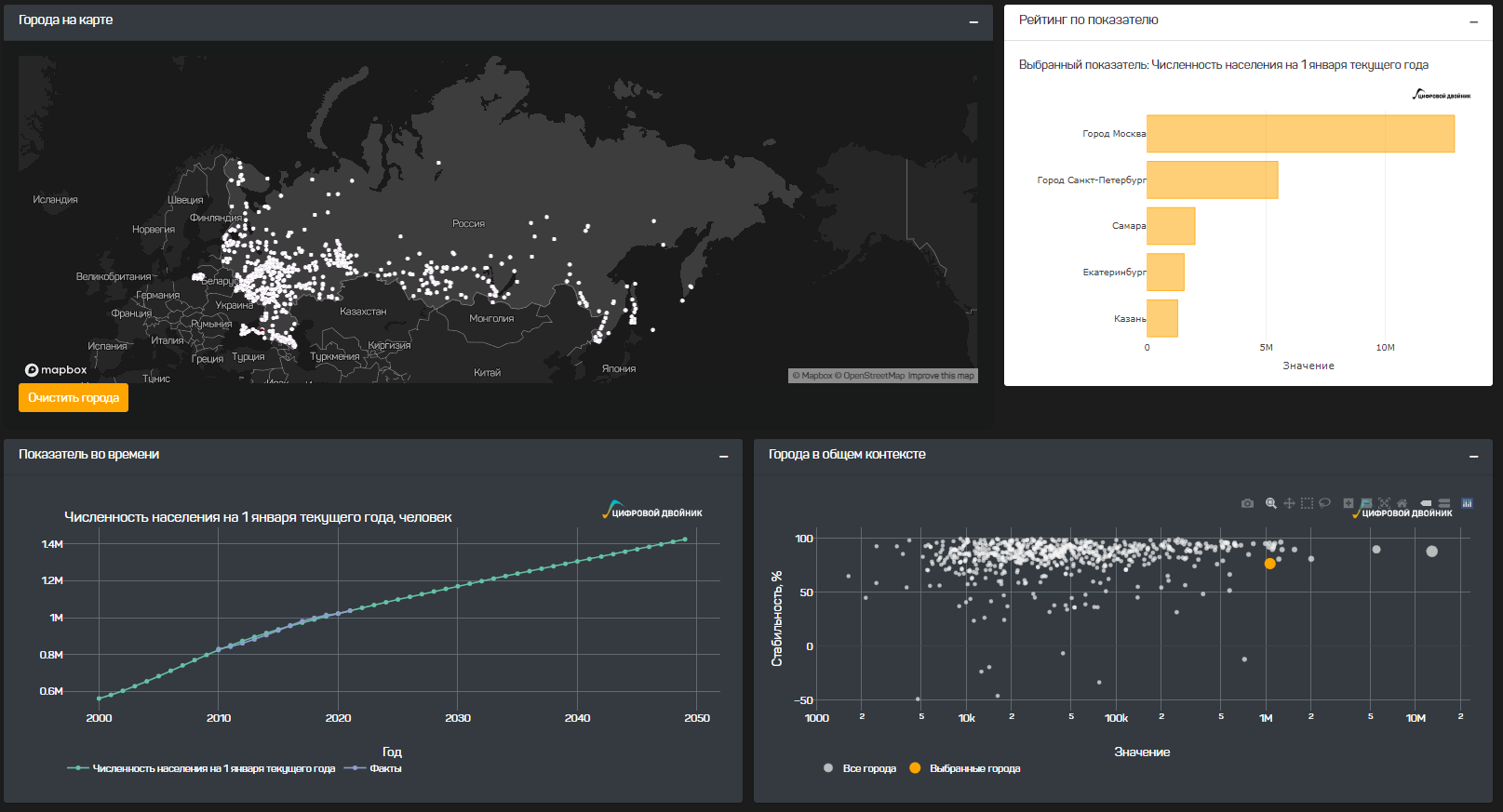
Figure 3 — Territory monitoring dashboard: map, rankings, and indicator trends
4.3 Decision support
The CDT gives government bodies, enterprises, and expert organizations a full toolkit to analyze scenarios, assess outcomes, and choose the best decisions under limited resources, competing goals, and a highly uncertain environment.
The platform supports decision-making at every stage of the management cycle:
- setting goals and options for action;
- calculating resource availability and possible constraints;
- modeling scenarios and implementation options;
- analyzing sensitivity to changes in key parameters;
- justifying the choice of preferred paths.
CDT features include:
- scenario modeling across the socio-economic, demographic, spatial, and energy dimensions;
- simulation of how different programs and policies interact;
- integration of outcome assessment with budget-efficiency calculations;
- automatic comparison of decisions against target indicators and constraints;
- visualization of development options and their effects.
By integrating digital models of the fuel and energy complex (FEC), government bodies and enterprises can factor energy considerations into their broader management and investment decisions. The models include:
- how territorial development depends on energy supply and network capacity;
- consumption trends across different economic sectors;
- an assessment of energy-balance resilience under various strategies;
- upgrade options and their effects on budget and infrastructure resilience.
In short, the CDT does more than collect and analyze data — it serves as a platform for digital modeling and for preparing well-grounded decisions that guide how you manage the development of a territory and its individual sectors, including energy.
4.4 Integration with enterprise digital twins
The City Digital Twin platform was designed from the start as an open, extensible system that can integrate with external digital ecosystems, including corporate solutions, digital twins of production facilities, and industry and agency platforms.
Integration with enterprise digital twins happens at the level of:
- aligned classifiers and units of measurement;
- streaming exchange of structured data;
- joint modeling and scenario planning;
- accounting for territorial, resource, and infrastructure constraints when carrying out investment programs.
This kind of interaction makes it possible to:
- factor business needs and constraints into the digital modeling of a territory’s development;
- coordinate the priorities of government and production stakeholders;
- embed corporate solutions (including at the SCADA, MES, and ERP levels) into the overall picture of resource supply and socio-economic planning.
In the fuel and energy complex, this matters especially when:
- planning energy consumption and generation;
- assessing the availability of network capacity;
- designing upgrades and new production facilities;
- coordinating the schedules and parameters of power and heat supply.
The CDT provides a common interface and exchange standards, so private and public organizations can build a digital partnership with government bodies based on open data, models, and transparent calculations.
This approach makes it possible to put into practice the idea of developing territories and industrial systems in step with each other — on a shared digital foundation and through interconnected scenarios.
All rights reserved Digital Twin LLC All rights reserved Digital twin LLC