Chapter 5 General architecture of the platform
5.1 Architectural vision
The City Digital Twin (CDT) platform is built as a modular, scalable digital system that consolidates, normalizes, calculates, and interprets socio-economic data for government and corporate management. It brings together a multi-layered organization of data, analytical tools, and integration services that meet today’s requirements for digital solutions in managing the development of territories and sectoral systems.
The platform implements five key architectural layers:
- Data — data marts and stores, reference books, sources of statistics, accounting, and reporting, all verified and unified;
- Analytics and models — a set of computational and forecasting modules: demographics, macroeconomics, intersectoral links, energy, logistics, potentials, and deficits;
- Presentation — monitoring dashboards, reporting forms, and visual output templates;
- Interaction — application programming interface (API) mechanisms, exchange scenarios, calculation exports, and integration with external information systems;
- Management — versioning, access control, execution tracking, parameter approval, and digital-trail preservation.
The modular design lets you use the CDT as an end-to-end digital loop that covers the full information cycle: from loading and normalization to analytics, indicator calculation, forecasting, and the creation of final decision passports.
The platform includes a transport-economic model that accounts for the limits and opportunities of the logistics network linking populated areas. The model uses coordinates, road characteristics, and capacity metrics to assess how transport infrastructure affects the economy, resource access, production costs, and the planning of project locations. This component is built into scenario and balance calculations, and it also feeds the calculation of provisioning and resilience indicators.
Special attention goes to preparing and verifying socio-economic development (SED) indicators, which feed, among other things, the drafting and refinement of fuel and energy balances (FEB), as well as spatial and strategic planning programs. The platform ensures traceability for every value, its origin, and its calculation logic.
The CDT follows the architectural approaches set out in GOST 34, RD 50, the recommendations of the Ministry of Economic Development and other agencies, and the technical requirements for digital platforms in public administration and sectoral information systems. The architecture is designed to grow, integrate with external digital twins, and adapt to the needs of federal subjects (regions), sectors, and agencies.
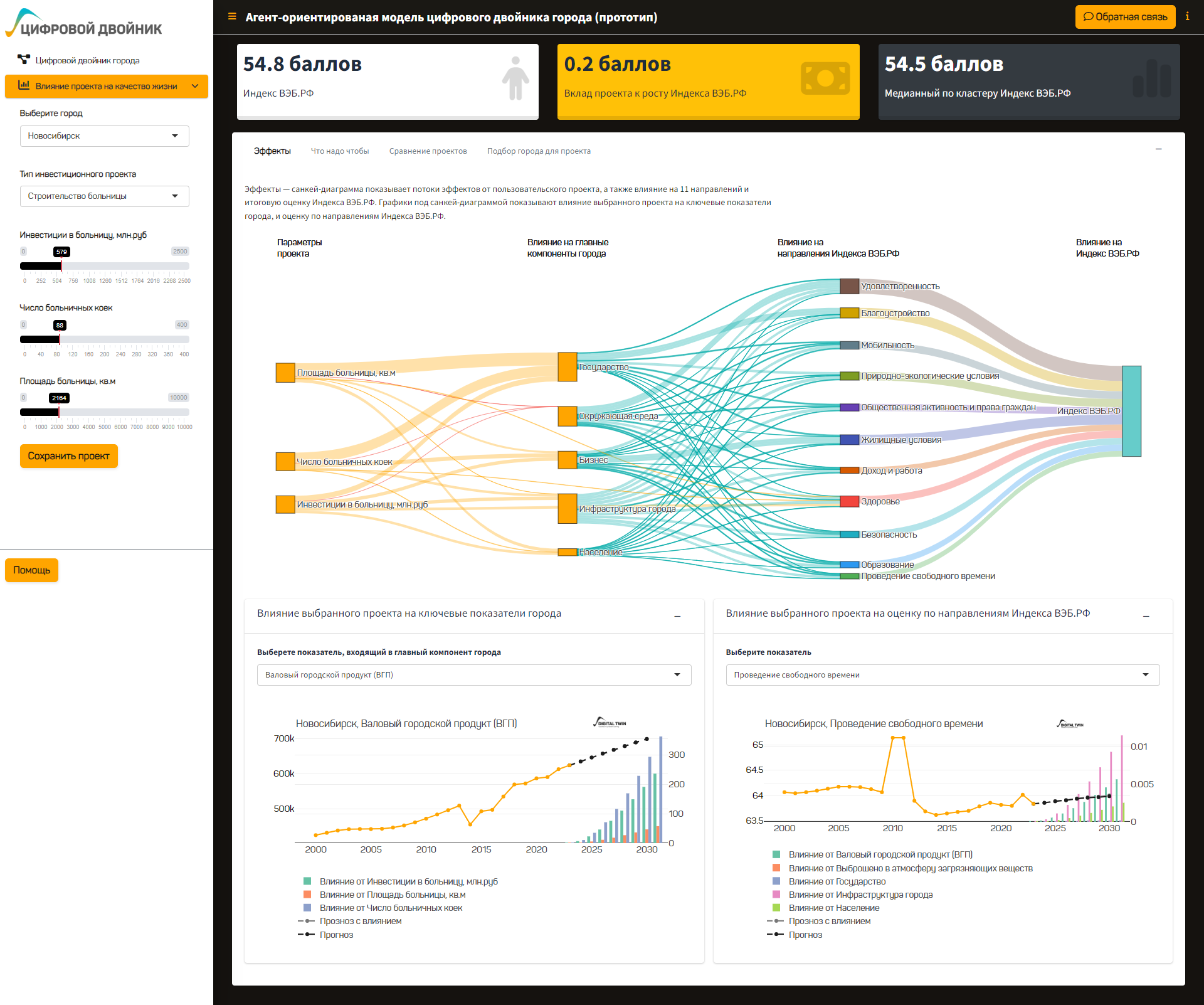
Figure 4 — Model for assessing how an investment project affects city indicators: a Sankey diagram and effect charts
5.2 Business architecture
The business architecture of the City Digital Twin (CDT) platform describes how users, functions, and target management processes interact within the system. It defines which tasks government bodies, agencies, enterprises, and analytical centers solve using a shared digital space, data, and models.
The architecture centers on the key business functions of territorial governance:
- collecting and verifying data;
- analytics and indicator calculation;
- assessing scenarios and plans;
- monitoring execution and deviations;
- creating decision passports and exporting indicators to adjacent systems.
The platform serves these levels of management:
- Federal — analytical support for delivering national goals, modeling the effects of sectoral and regional decisions, and tracking the effectiveness of government programs;
- Regional — calculating and monitoring development indicators for federal subjects (regions), integrating with sectoral and municipal systems, and building regional programs and assessing their resilience;
- Municipal — preparing development plans, assessing resource provisioning and logistics access, calculating indicators, and tracking execution;
- Enterprises and development institutions — matching projects to the territorial situation, assessing infrastructure access, and analyzing prospects and risks.
The platform’s functions group into business blocks:
- Data and reference books — structured sources, regulatory bases, and classification bases;
- ETL and calculations — chains for preparing, transforming, modeling, and calculating indicators;
- Monitoring and visualization — displaying indicators and tracking execution;
- Decision support — creating activity passports, scenario assessments, and resilience scenarios;
- Integration — export and synchronization with external digital twins, planning systems, and analytical platforms.
The platform builds a “data — model — indicators — decision — export” business logic, letting users at any level work within a single, managed ecosystem. This logic scales to sectoral tasks, including fuel and energy provisioning, logistics resilience, and the efficiency of project decisions.
5.3 Data architecture
The data architecture of the City Digital Twin (CDT) platform is a domain-oriented, multi-layered model that consolidates, normalizes, calculates, and stores information in a structured way to support the management of territorial development.
The database runs on ClickHouse, an industrial database management system optimized for high-speed analytical queries, aggregation of large data volumes, and concurrent use by many users.
The data model includes four key layers:
- Reference layer — classifiers for territories, indicators, sources, units of measurement, and object types;
- Historical series — data from official statistics, agency reports, administrative registries, and municipal-level sources;
- Calculation layer — derived indicators, forecasts, index estimates, and model calculation results;
- Data marts — aggregated forms prepared for export, reporting, and visual presentation to the user.
The database architecture supports:
- multiple territorial levels (federal, regional, municipal, settlement);
- different periods (year, quarter, month);
- storage of calculation and scenario versions;
- integration with calculation, visualization, and API modules.
The system uses table-linking mechanisms and a graph structure of interdependencies between indicators, which lets you trace where values come from, build cause-and-effect links, and create composite indicators from source data.
The CDT data architecture provides flexibility, scalability, and a reliable foundation for automated analytics, calculations, and reporting within territorial governance processes.
5.4 Application architecture
The application architecture of the City Digital Twin (CDT) platform follows a microservice approach and includes independent functional components that handle data preparation, modeling, indicator calculation, visualization, and integration with external systems. Each application service targets a single, logically complete function, which lets you scale the system, add new modules, and adapt it to the specifics of a region or agency.
The key CDT application components include:
- ETL pipelines — modules for sequential data processing (ETL-1 — preparation and normalization, ETL-2 — modeling and forecasting, ETL-3 — calculation of target indicators, ETL-4 — decision passporting and result aggregation);
- Monitoring module — interfaces for building dashboards and displaying current values, deviations, trends, and change history;
- Visualization module — building reporting tables and structured presentation forms, and exporting machine-readable extracts;
- Resilience and sensitivity calculation module — tools for comparing scenarios, analyzing the impact of constraints, and calculating risk and balance indices;
- Decision passport — a module that generates a formalized brief (passport) for project, program, or budget decisions, with indicator calculations and an option to import into external systems.
The application architecture implements API gateways for interaction with external agency systems, corporate platforms, digital twins, and sectoral sources.
The application architecture uses containerization (Docker), with the option to orchestrate through standard solutions, which simplifies updates, scaling, and security support.
This structure lets you use the CDT in flexible scenarios: as an internal analytical-support platform, as a tool for aligning decisions across levels of government, and as an exportable solution deployed in the customer’s infrastructure.
5.5 Technology architecture
The technology architecture of the City Digital Twin (CDT) platform is designed with a focus on reliability, performance, cross-platform support, and compliance with digital sovereignty requirements. The platform deploys as a distributed application built on modern data-processing tools and open-source solutions.
The main components of the technology stack:
- ClickHouse — the primary DBMS for storing and analyzing large volumes of aggregated data;
- PostgreSQL (optional) — for maintaining reference books, transactional tables, and administrative information;
- R + RStudio Server — for calculations, built-in modeling, and analytics (ETL-2, ETL-3, ETL-4);
- Seafile or equivalent — for storing extracts, reports, reference files, and intermediate results;
- GitLab CE — for storing model versions and change control;
- Docker — for containerizing components and managing dependencies and deployment;
- Nginx + API gateways — for external access, routing, and secure interaction.
The platform is fully compatible with Astra Linux–based operating systems and can deploy in the customer’s infrastructure — on physical servers or in a virtualized environment. The technologies used meet import-independence requirements and can be adapted to secured environments.
The infrastructure supports scaling at the compute, data, and user levels. Modules can deploy in a single environment (mono-deployment) or as a distributed complex. The platform supports standard security protocols, action logging, and calculation-integrity control.
The CDT technology architecture ensures independence from narrow vendors, flexible updates, transparent logic, and the ability to localize all components without losing functionality.
All rights reserved Digital Twin LLC All rights reserved Digital twin LLC