Chapter 6 Functional architecture
This chapter explains how the City Digital Twin (CDT) platform works as a single digital system that supports data management, modeling, monitoring, and analytical decision support. It walks through the main functional blocks — from the pipelines that collect and process information to visualization, scenario modeling, sensitivity analysis, report generation, and the mechanisms that integrate the platform with outside systems. The chapter shows how the platform runs a closed, data-driven management loop and how its functionality adapts to the tasks of different levels of government and different industries.
6.1 Data collection and preparation (ETL)
The ETL (Extract–Transform–Load) block in the City Digital Twin (CDT) platform runs a continuous process that collects, normalizes, aggregates, and prepares data coming from many different sources. Its job is to turn scattered statistical, accounting, and administrative datasets into a clean, comparable information base that is ready for modeling.
The ETL process is organized as a sequence of stages (pipelines), and each one handles a specific task:
- ETL-1: collect data from municipal, regional, federal, and international sources; recode it; remove errors; normalize it; and build a single data mart;
- ETL-2: run the calculation models — demographics, economics, intersectoral links, and others — on the unified data;
- ETL-3: calculate target indicators, indices, sensitivity matrices, deficits, surpluses, and derived indicators;
- ETL-4: prepare aggregated decision passports, generate scenario profiles, calculate resilience, and link results to program goals.
Every stage is automated, transparent, and reproducible. The data passes through validation, logical checks, and versioning. The platform keeps the sources and records the key fields in the structure, so you can not only use a result but also explain where it came from.
The ETL pipeline is easy to extend for new tasks: a digital model of the fuel and energy complex (FEC), building and forecasting fuel and energy balances (FEB), calculation models for the Ministry of Agriculture, integration with the work of the Federal Financial Monitoring Service, environmental services, or new federal indicators. A new task is built as a separate module or a branch inside an existing pipeline, without disrupting the core blocks and without affecting the stability of the whole platform.
The ETL blocks are designed for scalability — you can add new sources, regions, formats, and reports without rebuilding the logic. This functionality is the basis for every calculation, model, and visualization in the CDT, and it forms the “digital foundation” of the entire system.
6.2 Visualization and monitoring
The “Visualization and monitoring” block of the City Digital Twin platform presents key indicators, process dynamics, and calculation results in a form that is clear and easy to manage. It serves users at every level of government — from a municipal specialist to a federal analytical center — and follows the principles of openness, reproducibility, and evidence-based analytics.
The visual interface is built around:
- interactive dashboards with indicators broken down by territory, period, and scenario;
- summary monitoring panels that show deviations from target values, flags for problem areas, and visual scales;
- mechanisms for comparing scenarios and tracking how sensitive indicators are to changes in input parameters;
- table views and report forms that match the rules for departmental and interdepartmental reporting.
Data flows into the visualization block directly from the calculation modules (ETL), which gives you:
- up-to-date information;
- indicators that stay in sync across sections;
- full traceability of value sources (from the model to the visual block).
The system lets you save user templates, export images and tables, configure access rights, and display different levels of detail (from regions down to individual consumer categories or service types).
Separate monitoring modules handle data verification, resilience assessment, comparison of territories, and tracking progress toward the targets of national and regional programs.
The “Visualization and monitoring” block makes the analytical side of the platform accessible to managers — letting them not only understand the numbers but also interpret them in terms of decisions, resources, and results.
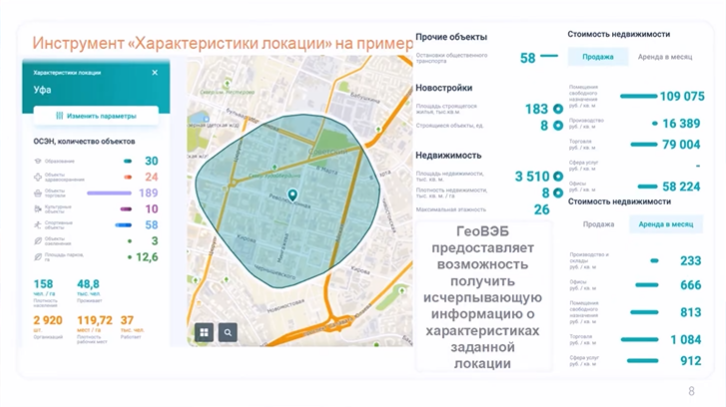
Figure 9 — The “Location characteristics” tool in GeoWEB: analysis of a territory’s infrastructure, real estate, and social facilities
6.3 Scenario modeling
The City Digital Twin platform includes built-in scenario modeling that lets you compare different development paths for a territory based on input parameters, constraints, and management decisions. This block helps you assess the consequences of different approaches to planning and resource allocation — at the municipal level as well as across a region or a government agency.
The platform ships with two base scenarios by default:
- Inertial scenario — shows development along the current path with no extra outside intervention, keeping the existing trends in place;
- Investment scenario — builds on the inertial scenario and also accounts for planned and active investment development programs.
Both scenarios use the same models and data sources, so you can compare results directly: demographics, economics, resilience, deficits, potentials, and program performance indicators.
The platform’s architecture also lets the customer or an expert group create custom scenarios. You can parameterize the initial conditions, controlled variables, constraints, time horizons, and assumptions. Scenarios are saved and versioned, and you can use them in reports, decision passports, and strategic management decisions.
Modeling results are available for visual comparison, sensitivity assessment, and deviation analysis, and you can export them to related information systems and outside expert environments.
Scenario modeling lets you not only “see the future” but also manage it with data, adapting decisions to changing conditions and to the needs of a specific territory.
6.4 Sensitivity analysis
The sensitivity analysis function in the City Digital Twin platform assesses how individual parameters and assumptions affect the final values of models, indices, and target indicators. This matters especially in multi-parameter modeling and when management decisions carry a high degree of uncertainty.
The CDT automatically builds sensitivity matrices as part of scenario modeling and the calculations in the ETL modules. These matrices show how a change in specific variables (for example, population size, investment rates, or budget constraints) affects the resulting values: resilience indices, forecast deficits, balance indicators, and development dynamics.
The system lets you:
- identify the most sensitive parameters, which need tight control;
- understand the zones of risk and uncertainty in scenarios;
- determine which actions have the greatest management effect.
Sensitivity analysis results appear as tables, comparison charts, scales, and heat maps. This lets you make decisions that are not just well-grounded but also easy to explain, especially when you prepare justifications and reports.
The sensitivity mechanism is especially important when you align target models across levels of government, assess acceptable error margins, and compare alternative versions of a program or an investment project.
6.5 Report generation
The City Digital Twin platform includes dedicated functionality for automated report generation that meets the requirements of federal, regional, and departmental data formats. This block serves both regular administrative reporting and the preparation of materials for justifying decisions, building activity passports, and expert analytics.
The system can automatically generate:
- table reports with aggregated and source data;
- data marts of target indicators for national projects, strategies, and programs;
- documents in various formats, based on approved templates;
- passports for programs, projects, and scenarios, complete with calculations, visualizations, and explanatory sections;
- machine-readable exports for loading into outside information systems.
Reports are assembled from the data prepared in the ETL modules and calculations, which gives you:
- consistent values across every section of the document;
- traceability of the sources and the logic behind the figures;
- adaptation to a territory, period, scenario, or departmental structure.
Each report block comes with mechanisms for versioning, comparing changes, and visually comparing versions. This makes it easier to verify correctness, protect managers during audits, and support official correspondence.
The reporting module works as a standalone component and as a link between calculations, visualization, and the regulatory framework of reporting obligations.
6.6 Integration and API
The City Digital Twin platform was designed from the start as an open, integration-friendly system that can work effectively with outside digital platforms, government information systems, and corporate solutions. To make this possible, the CDT provides a universal API layer and a set of data exchange standards.
The functionality includes:
- a REST API that gives access to data, calculation results, scenarios, and generated reports;
- export of calculated and aggregated data in JSON, CSV, XLSX, and XML formats;
- support for importing outside reference books, parameters, indicators, and statistics, with automatic validation and transformation;
- data exchange between different deployment levels of the platform.
The system supports access control for the API by role and scenario: an outside consumer can receive only approved, public, or agreed-upon data. For more complex integrations, the platform provides business process templates automated by subscription or schedule.
The CDT integration layer lets you:
- embed results into reports with no manual handling;
- use the CDT as a source in monitoring and analysis systems;
- build digital links with industry-specific or object-oriented digital twins.
Thanks to its interaction standards, the platform connects easily to the existing IT infrastructure of government bodies and companies, while keeping data manageable, traceable, and compatible.
All rights reserved Digital Twin LLC All rights reserved Digital twin LLC