Chapter 2 Problem domain
Despite the spread of digital technologies and the legal backing for strategic governance, Russia’s system for managing cities and territories still suffers from fragmentation, unstructured data, and a lack of modern decision support tools. This matters most in areas like energy, territorial infrastructure management, social policy, and the delivery of national goals. This chapter lays out the key structural problems that government bodies and enterprises run into: scattered data, manual planning, the absence of reliable energy balances, and missing digital models of the fuel and energy complex. The City Digital Twin (CDT) platform tackles these gaps systematically, building the foundation for safe, well-grounded, and effective management.
2.1 Where city governance stands today
The system for managing cities in the Russian Federation is heavily regulated, yet it offers only limited information and analytical support for decisions.
1. Scattered data and limited digitization
In most cities and municipalities, data on infrastructure, socio-economic indicators, housing and utilities, and investment projects is scattered. It sits in departmental spreadsheets and is never tied into a single system.
The existing geographic information systems (GIS), utility platforms, cadastral registries, and statistical datasets are not integrated. They update on different schedules and use different data structures and access levels. Local governments often lack both the expertise and the resources to consolidate and analyze all of it.
2. Operational planning and reporting crowd out strategic management
City and municipal administrations focus largely on executing current budgets and reporting up the chain. This produces fragmented, short-term management that makes it impossible to build durable development programs, infrastructure investments, and social change.
At the level of federal subjects (regions), strategic planning usually lives in paper documents and PowerPoint slides, with no monitoring system and no evidence to back it up.
3. Weak links between strategies, investment, and infrastructure
Even when strategies and master plans exist, there’s no connection between development goals and the real budget and infrastructure that would deliver them. Often no one checks whether the goals have the resources to back them, no one models risks and scenarios, and there’s no feedback mechanism.
This is especially true in the fuel and energy complex (FEC), where cities and regions:
- don’t produce their own forecast fuel and energy balances;
- don’t integrate data on consumption, capacity, and constraints;
- don’t analyze how infrastructure decisions depend on energy supply.
4. Weak analytical support and manual decision-making
In municipalities, and even at the regional level, decisions get made by hand — based on expert opinion, intuition, or outdated information. Analytical teams often work in Excel files, with no access to current data, modeling tools, or visualization.
5. No end-to-end digital infrastructure
Several digital systems exist (the housing and utilities GIS, Rosreestr, the Unified Interdepartmental Statistical Information System), but none of them supports management end to end. Interdepartmental coordination is limited, data is hard to reconcile, and the digital services don’t cover the core management processes, including:
- modeling goals and indicators;
- intersectoral and cross-fuel analysis (the fuel and energy balance, FEB);
- justifying scenarios and investment decisions.
Today’s city governance system has no:
- unified digital twins that bring together data, models, and interfaces;
- tools to support scenario-based, resource-based, and strategic management;
- tools that connect social, economic, and energy processes.
This creates a lasting gap between stated goals and the real machinery of governance, and it limits the effectiveness of national projects and investment programs.
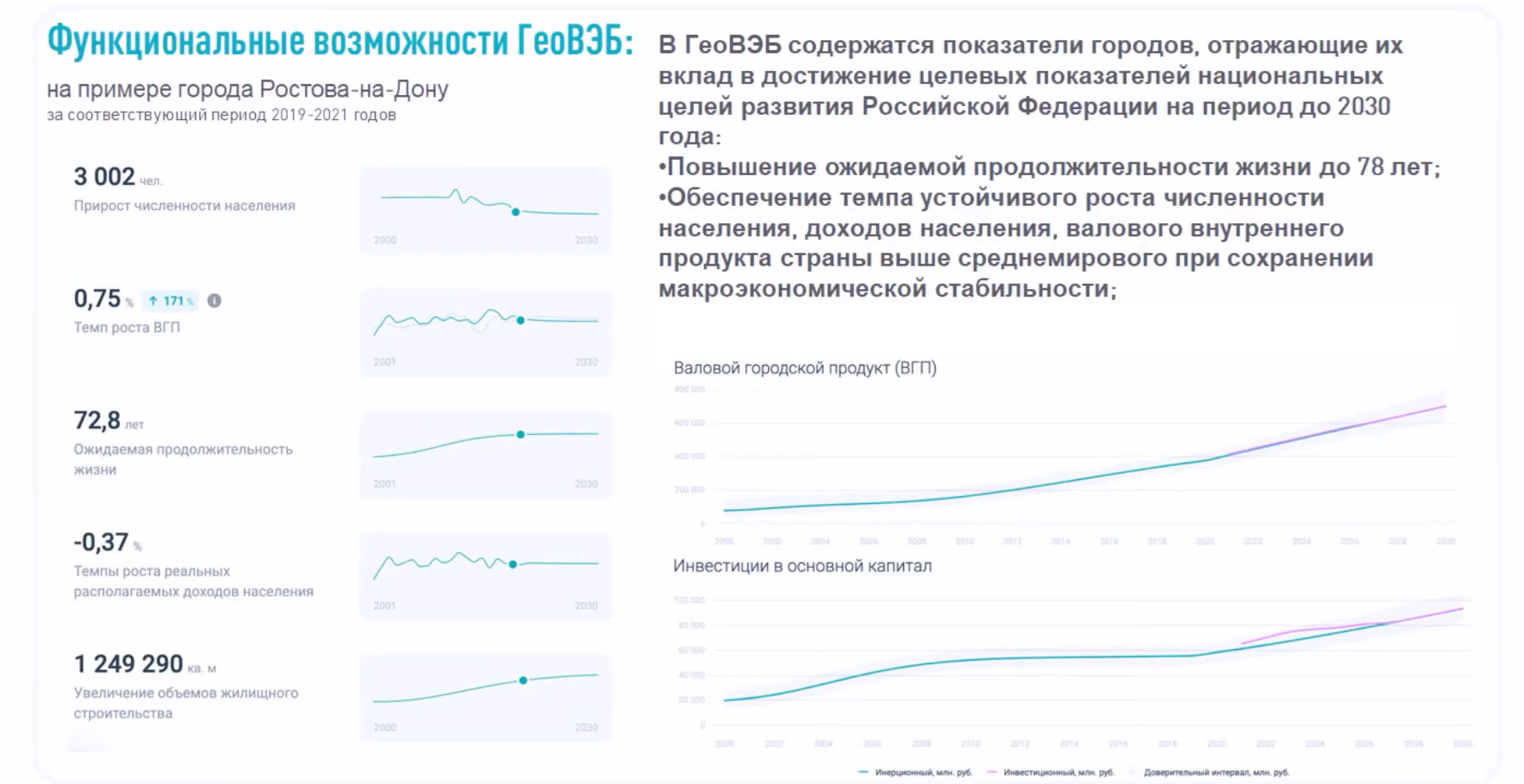
Figure 7 — GeoWEB capabilities, shown for the city of Rostov-on-Don: indicators, trends, and scenario forecasts
2.2 Scattered data and data quality
1. Distributed, inconsistent sources
In territorial management today, data is split across dozens of disconnected systems: Rosstat, the Federal Tax Service, the housing and utilities GIS, cadastral registries, regional information systems, and departmental reporting forms. Each system runs on its own logic, with a different update frequency, structure, and degree of openness.
As a result:
- government bodies lack a coherent picture of the current situation;
- automated consolidation of information is impossible;
- the risk of deciding on incomplete or outdated data goes up.
2. The currency and verification problem in the FEC and FEB
The fragmentation problem shows up most clearly in the fuel and energy sector. Computing fuel and energy balances (FEB) requires integrating data from:
- statistical forms (No. 4-TER, 46-EE, 1-ZhKH, 22-ZhKH);
- departmental information systems (regional, municipal, corporate);
- technical and economic characteristics of equipment and infrastructure;
- commercial metering systems, SCADA, and IoT devices at FEC enterprises.
In practice:
- data gets collected by hand in Excel;
- reporting forms don’t match in structure or volume;
- there’s heavy duplication, inaccuracy, and mismatched units of measure.
The CDT automates data collection, cleaning, and normalization, producing verified datasets that are ready for analysis and visualization.
3. No unified storage structure or interdepartmental exchange
Data sits in isolated tables with no agreed-upon structure, identifiers, or formats. Interdepartmental exchange is limited, and on the ground even basic indicators are kept in local copies with no change logs and no quality control.
This is especially critical when analyzing:
- distributed infrastructure (power grids, heating substations, generation, transport);
- consumers (residential, industrial, and public-sector categories);
- network constraints and losses.
The CDT solves this by building an end-to-end information model with universal identifiers, classifiers, and data versioning.
4. No way to validate and compare alternative sources
When working out decisions, government bodies often get conflicting numbers from different systems and have no tools to compare and reconcile them. This leads to errors, blame-shifting, stalled initiatives, and a retreat from scenario modeling.
The CDT platform offers:
- built-in mechanisms to compare alternative sources;
- flexible rules for prioritizing data (for example, by trust level);
- visualization of discrepancies and validation control at every stage of a calculation;
- “stitching together” of scattered datasets — especially useful for building consolidated fuel and energy balances.
5. The impact on decision-making
Without consolidating, verifying, and embedding data into models, it’s impossible to:
- objectively assess the current state of infrastructure;
- model demand and network load;
- calculate energy supply adequacy;
- plan investment programs and assess their consequences.
Data quality directly shapes the quality of management — especially in energy, where mistakes lead to financial losses, the risk of failures, and wasted budget money.
Scattered data isn’t just a technical problem. It’s a constraint on strategic management, on delivering national projects, and on developing territories. The CDT removes these constraints by building a single, verified, reliable, machine-readable information base.
2.3 Why current solutions fall short
1. Existing digital solutions are limited
The number of information systems used by government bodies keeps growing, but most of them:
- were built for departmental tasks and don’t cover cross-sector or spatial relationships;
- handle accounting and reporting but offer no tools to model and justify decisions;
- can’t embed analytics into managers’ daily work, stopping at forms and data exports.
The existing platforms (the Unified Interdepartmental Statistical Information System, the housing and utilities GIS, the analytical systems for government bodies, the feedback platform, 1C solutions) don’t provide a coherent model for managing a territory, and they don’t connect to digital fuel and energy balances, energy modeling, or scenario analytics.
2. Many Excel solutions and manual labor
In practice, decisions and forecasts in cities, federal subjects, and even federal bodies are made on the basis of Excel spreadsheets assembled by hand from scattered sources.
This leads to:
- constant re-entry of the same data;
- more errors and unreliable analytics;
- no versioning and no transparency in calculations;
- no way to reproduce a model.
The problem is sharpest in energy, where in most regions even FEB calculations are done by hand and scenario calculations don’t exist at all.
3. No unified digital model of the FEC
The FEC determines:
- the reliability of infrastructure;
- the stability of a region’s economy;
- the availability of housing, transport, and production capacity.
Yet decisions about developing energy are made with no digital tools behind them. At the same time:
- energy demand forecasts are built by hand or not built at all;
- fuel and energy balances are put together on a “nameplate” basis;
- decisions on power supply, gasification, generation, and heat supply are made in isolation, with no link to social and economic goals.
As a result:
- investment in energy infrastructure is planned inefficiently;
- there’s no way to assess risks and failures early;
- the principles of interdepartmental coordination and systemic thinking aren’t followed.
4. No platform to support management decisions
Cities and regions are managed without tools that would let leaders:
- calculate needs and scenarios;
- analyze how sensitive decisions are to constraints;
- manage goals, risks, options, and consequences;
- assess whether plans have the resources to back them (including energy).
Instead of a platform approach, the fragmented “data — calculation — report” logic persists, and it never closes the management loop.
5. No way to explain and prove effectiveness
One of the biggest problems with today’s management system is the lack of an evidence base behind the decisions that get made. No existing IT solution:
- preserves the history of calculations;
- records the model behind a justification;
- supports validation of data and results.
This matters most for public officials, who bear personal responsibility for using budget money for its intended purpose and effectively.
The CDT lets you:
- model alternative scenarios;
- save and justify every step;
- build a documented evidence base for decisions;
- integrate with reporting and oversight systems.
The existing approaches and systems:
- don’t handle integrated management of cities and the FEC;
- don’t support scenario-based, strategic, and evidence-based modeling;
- don’t let an official feel protected when it comes to whether their decisions were well-grounded.
The City Digital Twin removes these shortcomings. It works not just as a platform for analysis, but as a platform for reliable, reproducible, documented management of how territories and the fuel and energy complex develop.
2.4 What unresolved problems lead to
1. Decisions made blind
Without reliable, current, reconciled data:
- decisions get made on intuition, for formal or political reasons;
- there’s no way to model the consequences of a chosen scenario;
- officials and managers can’t explain the logic behind their decisions during audits or public inquiries.
This is especially critical in energy, fuel and energy balances, and social development, where mistakes lead not to course corrections but to infrastructure failures, budget losses, and criminal cases.
2. Development programs and national projects fail
When goals and resourcing go unvalidated, the result is:
- national goals and indicators that go unmet;
- planning on paper with no real delivery;
- failed programs to modernize housing and utilities, digitize the FEC, and develop territories in an integrated way.
The consequences:
- regions miss their key performance indicators;
- a region loses federal funding;
- heads of municipalities and regions take on personal responsibility.
3. Production and energy risks for enterprises
For businesses, the lack of an integrated development model means:
- too little information about network infrastructure and capacity;
- unplanned limits on connections and resource distribution;
- rising tariffs and costs caused by inefficient planning on the government’s side.
In the FEC the consequences are more critical:
- no reserves and no readiness for peak loads;
- no way to prove a project is a sound investment;
- growing carbon and energy uncertainty.
The result: lower margins, capital flight, and a loss of competitiveness.
4. Personal and legal risks for public officials
Without verified digital models:
- any act, program, or decision can be ruled unjustified;
- any deviation can be read as abuse of authority;
- oversight bodies have no access to the calculation system, and all the responsibility falls on the individual who carried it out.
The result:
- investigations by the Accounts Chamber, the prosecutor’s office, and the Federal Antimonopoly Service;
- a freeze on further funding;
- criminal cases for misuse of funds.
5. A closed loop of errors
When decisions rest on poor data and aren’t tracked over time:
- errors pile up;
- correcting course is impossible without losing face;
- control slips away, and trust in government erodes — both up the chain and among the public.
This leads to:
- rising protest sentiment;
- failed infrastructure and social decisions;
- an inability to spend even the budgets that have been allocated.
The City Digital Twin platform lets you:
- build an evidence base behind every management decision;
- forecast consequences before they happen;
- give territories, data, and goals digital connectivity;
- protect the official from risk and the enterprise from losses;
- shift management from going through the motions to real results.
All rights reserved Digital Twin LLC All rights reserved Digital twin LLC