Chapter 3 Goals of the system
This chapter lays out the core goals behind building and rolling out the City Digital Twin (CDT) platform. These goals aim to transform how government runs, make investment more effective, and keep regional energy supplies stable.
3.1 Strategic goals
The City Digital Twin (CDT) platform supports the strategic goals of the Russian Federation for the digital transformation of government, the spatial and socio-economic development of territories, stronger energy resilience, and technological sovereignty.
The platform creates a single digital perimeter that delivers:
- reliable, reproducible, and evidence-based analytics;
- forecasts and clear justification for management decisions;
- modeling of complex territorial and intersectoral processes;
- digital verification of progress toward goals, including in energy and infrastructure resilience.
3.1.1 Key strategic tasks the CDT handles
1. Supporting national goals and priorities The platform calculates, monitors, and models progress on the goals set out in Russian Presidential Decree No. 474 of July 21, 2020, and in the strategies that followed (including those running through 2036). These cover health, a comfortable environment, rising incomes, digital transformation, and the sustainable development of territories.
2. Building a single digital model for managing a territory The platform pulls scattered data, departmental models, and sources into one end-to-end digital model of the city and the region. This lets you manage territories with calculations, scenarios, and resources instead of intuition.
3. Developing a digital model of the fuel and energy complex and regional energy security The platform systematically builds and analyzes fuel and energy balances (FEB), which the energy sector needs for sustainable development, lower risk, and adaptation to new technological, tariff, and climate challenges.
4. Making government policy more effective and manageable The CDT helps authorities at every level move from formal planning to hands-on management of development, with full digital transparency, measurable results, and built-in feedback.
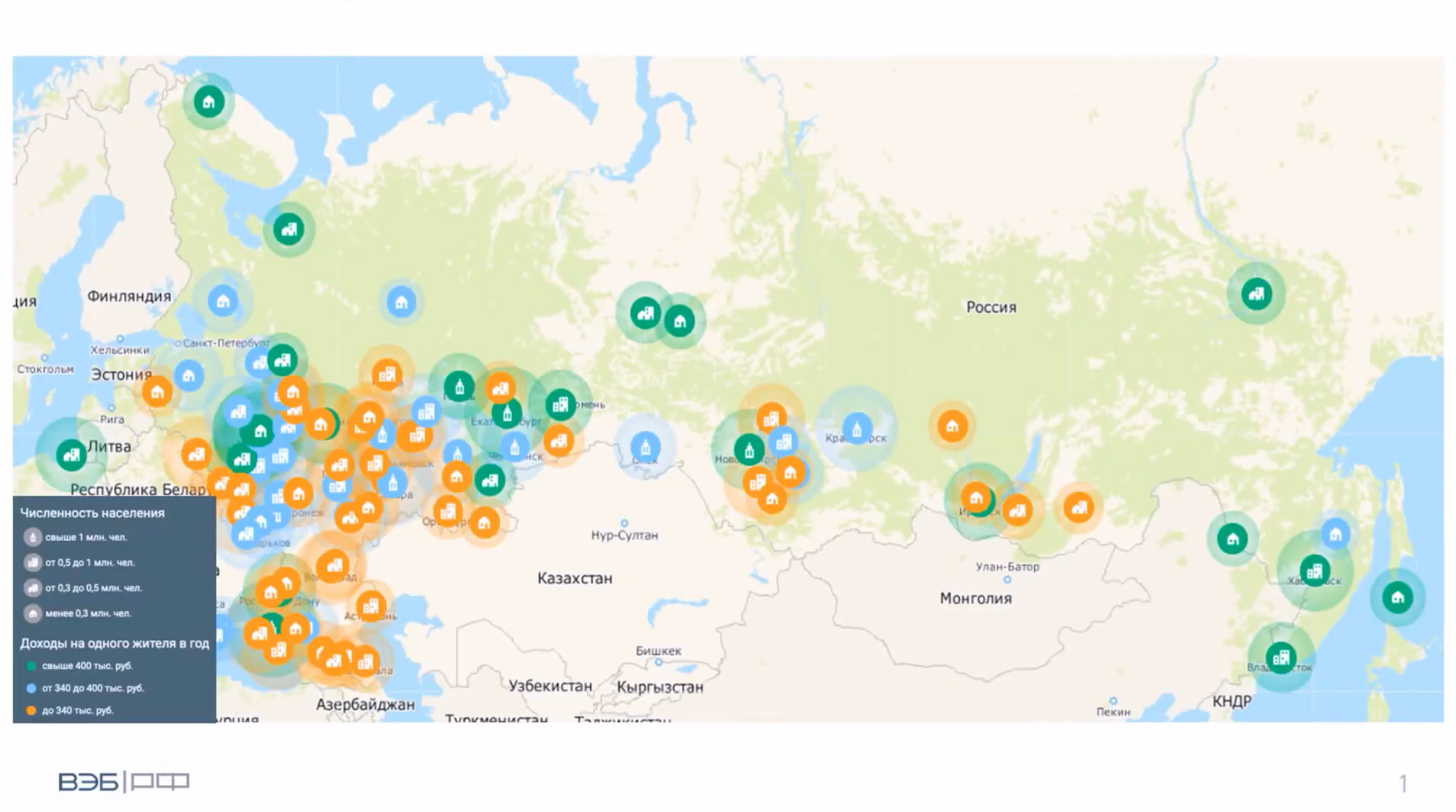
Figure 8 — Map of 100 cities in the Russian Federation in the GeoWEB system: population and resident incomes
3.2 Making decisions more transparent
Modern governance demands speed and accuracy, but it also demands transparency at every step — especially when you are accountable for delivering government programs, spending public money, and meeting national goals.
The City Digital Twin (CDT) platform makes management decisions transparent and reproducible at every stage — from setting a goal to calculating options, modeling outcomes, and monitoring results.
3.2.1 What makes the CDT transparent:
1. Verified data sources
Every calculation and every analysis in the platform draws on strictly defined sources — government statistics, departmental data, municipal registries, and fuel and energy complex (FEC) forms — that pass through automated validation and consolidation.
2. Documented calculation logic
Every management or investment decision made on the CDT comes with:
- accessible modeling logic;
- a saved version of the input parameters;
- a change history;
- a reference to the algorithms and models used.
3. Justified scenarios and parameters
The platform lets you work with alternatives — you can pick scenarios, parameters, and sensitivity levels, see the outcomes, and compare them. This rules out arbitrary choices and builds trust in the logic behind a decision.
4. Visualizing decisions and outcomes
You can visualize any decision on a map, in a graph, or through multi-factor indicators, including:
- the effect on target indicators;
- resource availability;
- overlaps with other programs.
3.2.2 Why transparency matters most in the fuel and energy complex and energy balances
In energy, these questions carry real weight:
- who built the balance;
- which data went into it;
- which scenarios it rests on;
- which forecasts were rejected, and why.
The CDT delivers:
- an end-to-end path from a departmental form to the final fuel and energy balance (FEB);
- visibility into every discrepancy between sources;
- a history of adjustments and decisions;
- exportable calculation models — for the Accounts Chamber, the prosecutor’s office, the Investigative Committee, and other oversight bodies.
3.3 Supporting national goals
The CDT platform is a tool for directly supporting the national goals and strategic initiatives set out in Russian Presidential Decrees and the corresponding government programs.
The CDT lets you:
- quickly calculate and model the key indicators tied to national goals;
- track progress toward goals by region, municipality, industry, and population group;
- spot the risk of missing a goal and adjust strategies in time.
It pays special attention to goals tied to:
- a higher quality of life and a more comfortable urban environment;
- the digital transformation of government;
- the sustainable development of territories;
- investment activity;
- energy efficiency and security.
The platform verifies indicators, models how achievable they are under different scenarios, and helps regional and federal authorities back up their actions and development paths with evidence.
3.4 Making public spending more effective
One of the core goals behind the City Digital Twin platform is to make public spending more effective and better justified — especially as the demands for efficiency, transparency, and sound justification of state and municipal spending keep rising.
The CDT lets you move from formally drawing down a budget to managing for results, based on evidence-driven models, analytics, and forecasting.
3.4.1 How the CDT makes budget spending more effective:
1. Building realistic, fully resourced programs
The platform lets you model needs and resources, match goals against capacity, and build balanced development plans — keeping out program “fictions” and measures that can’t be delivered.
2. Scenario modeling of investment outcomes
You can run any investment project, budget program, or regional initiative to check:
- resource availability;
- social and economic impact;
- alignment with development targets;
- delivery resilience and risk.
3. Tracking deviations and feedback
The CDT builds an end-to-end control loop over delivery, from planning through the execution report. It records and visualizes any deviation, compares it against the baseline scenario, and lets you adjust course as things change.
4. Supporting decisions that keep costs down
The platform lets you compare investment options and scenarios and pick the ones with the best ratio of cost to expected impact — including cross-sector effects, knock-on effects in adjacent areas, and reduced strain on infrastructure.
3.4.2 Greater efficiency in the fuel and energy complex and energy management
In the fuel and energy complex and in housing and utilities, regional and municipal spending is large, often opaque, and fragmented.
The CDT lets you:
- calculate and verify energy infrastructure needs;
- match spending against actual and forecast consumption;
- spot excess capacity, critical shortfalls, and inefficient resource allocation;
- build justified modernization plans, factoring in climate, social, and tariff considerations.
3.5 A digital model of the fuel and energy complex as part of strategic management
Building a digital model of the fuel and energy complex (FEC) and integrating forecast fuel and energy balances (FEB) are central to the CDT platform. Together they ground strategic and resource decisions in objective information.
The FEC module lets you:
- build and analyze actual and forecast fuel and energy balances in line with the methods of the Ministry of Energy and Rosstat;
- find imbalances and shortfalls in how resources are distributed across territories, consumers, and sectors;
- model scenarios for developing energy infrastructure and consumption;
- factor in tariff, climate, technological, and investment considerations when assessing whether development is sustainable.
The digital model of the fuel and energy complex plugs into the overall CDT structure, so you can assess how energy decisions affect target indicators for territorial development, the economy, infrastructure load, and environmental risk.
It provides a reliable information base for decisions at the federal and regional levels, as well as for companies in the fuel and energy complex.
All rights reserved Digital Twin LLC All rights reserved Digital twin LLC